 搜索
搜索


 搜索
搜索
Fixed and Variable Hotel Expenses
When hotels book more rooms, they require additional front desk agents to ensure long lines do not form at check in, extra cooks to cover the increased food and beverage volume, additional housekeepers to turn over a larger quantity of rooms, etc.
Resources are allocated within hotels on a daily basis to adjust for changes in guest volume. When hotels book more rooms, they require additional front desk agents to ensure long lines do not form at check in, extra cooks to cover the increased food and beverage volume, additional housekeepers to turn over a larger quantity of rooms, etc.
Typically, this process does not operate as efficiently in reverse. When hotel occupancy declines, the front desk staff does not quickly shrink, nor do the line cooks become unemployed, nor do the housekeepers disappear.
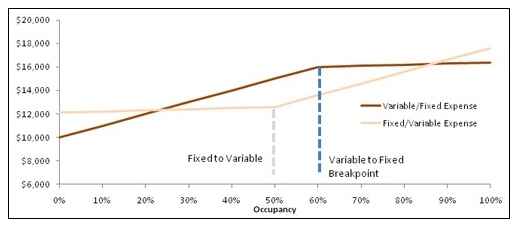
Because hotel management wants to be certain that occupancy declines are permanent and not waste training resources, some portion of these so called ‘variable’ expenses actually are fixed to a point along the occupancy continuum, and likewise some of expense categories traditionally thought of as ‘fixed’ are indeed variable at certain occupancy levels. Exhibit 1 illustrates this concept.
Exhibit 1: Conceptual Relationship of Mixed Fixed/Variable Expenses to Hotel Occupancy
Source: PKF Hospitality Research
To fully investigate the fixed/variable composition of hotel operating expenses, we use income statement data from hotels within the Atlanta market collected during the course of PKF Hospitality Research’s annual “Trends in the Hotel Industry” survey over the period 1994-2008. Data sets are separated into full-service properties (with retail F&B outlets) and limited-service properties (without retail F&B outlets) in consideration of fundamental differences in these property types.
We utilize a large set of piecewise regression models to quantify all expense items at each occupancy level from 40% to 80%. A full explanation of the modeling framework and results can be found on the PKF-HR website.
Plotting fixed / variable expenses
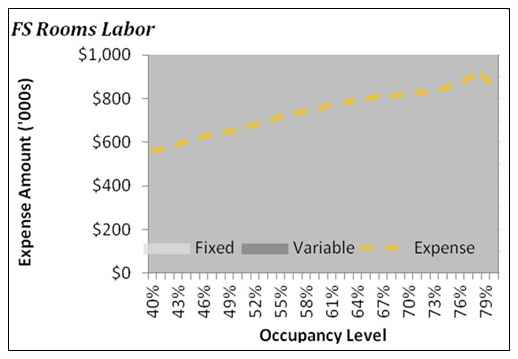
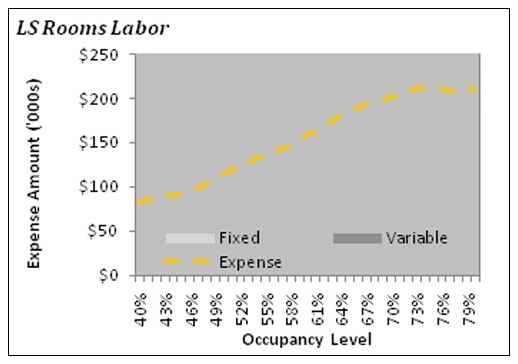
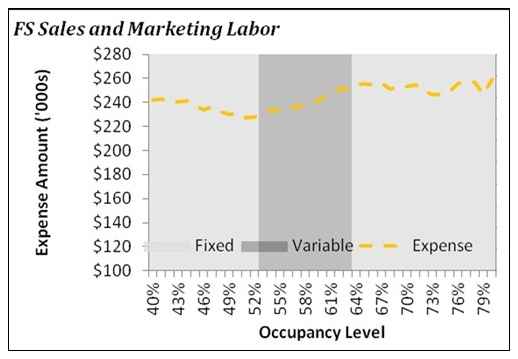
The labor graphs presented in Exhibit 2 depict the fixed/variable movement of expenses that occurred in a typical 300-room, full-service hotel in the Atlanta market, and a typical 120-room, limited-service hotel also in the Atlanta market for all occupancy levels, 40% through 80%. The x-axis plots the occupancy level, and the y-axis plots the corresponding expense level. The light shaded portion of the graph represents the fixed portion of the expense item and the dark shaded portion represents the variable portion. While both of these shaded areas can include both a fixed and variable portion, the demarcation of occupancy levels signifies a change in slope and therefore a change in the fixed/variable makeup.[page]
Exhibit 2 – Fixed and/or Variable Breakpoint Occupancy for Select Labor Expenses
Labor costs: Full-service hotels
Operated departmental labor categories include housekeeping staff, guest services, front desk agents, bell staff, line cooks, banquet servers, etc. These categories are dominated by hourly employees whose shifts are scheduled a week or two in advance when the occupancy of the hotel is known for each day of the scheduling period. As the property accommodates more guests, more employees are scheduled for shifts. As guest counts decline, the shifts of the existing employees are reduced, or in the case of a prolonged occupancy deficiency, eliminated altogether. This dynamic gives way to a variable expense category that is not just tied to number of people employed within the department, but to man-hours utilized.
In undistributed departmental labor categories, we find that a minimal staff is able to handle all occupancies up to 60%. Moving beyond the 60% occupancy level necessitates additional personnel to perform the administrative functions of the hotel. The individuals represented in the undistributed departmental labor categories (sales and marketing, and administrative and general) have a higher degree of specialization than their counterparts in the operated departmental labor categories, and are thereby less likely to disappear during times of occupancy constraint. These positions, however, are more likely to experience additional hours worked earning the same wage when occupancy increases than departmental labor positions would due to salary.[page]
Other costs: Full- and limited-service hotels
Other costs in the operated departments contain a large fixed portion. A minimal quantity of steaks, vegetables and other food items are necessary for dining outlets to operate. Linens, toiletries, and other guestroom supplies also must be stocked before a hotel can service guests. Our study has found that managers keep on hand enough supplies to service an occupancy level of at least 53% for full-service properties and 50% for limited-service properties, as displayed in Exhibit 3. When the property’s business increases, so does the ordering of supplies. When the full-service property’s business decreases, so does the supply inventory, but only to a level necessary to service a 53% (50% for limited-service) occupancy level.
Undistributed departmental other costs include office supplies, credit card fees, guest loyalty programs, supplies to maintain the property, etc. Contrary to historical beliefs, we found undistributed departmental expenses to be highly correlated with the number of guests staying in the property and, therefore, largely variable.
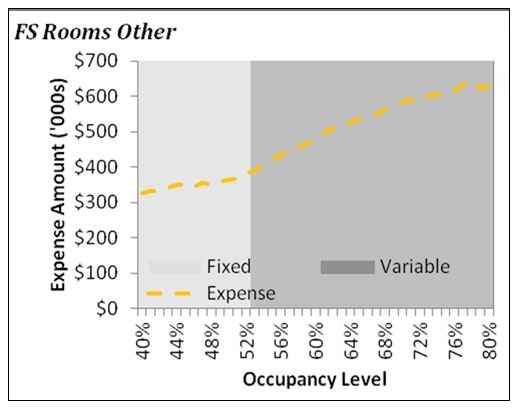
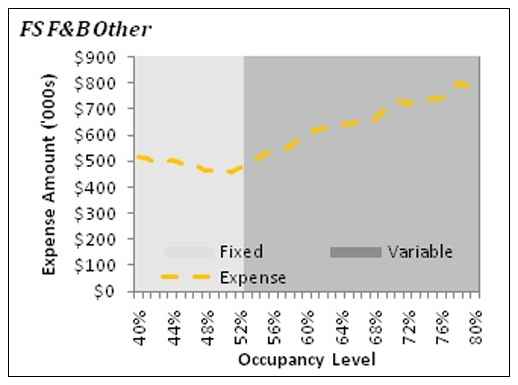
Exhibit 3 – Departmental Other Expenses
Source: PKF-HR annual Trends® in the Hotel Industry
0


