 搜索
搜索


 搜索
搜索
Savvy Pricing Strategies Mitigate Risks
Understand your channel contribution and channel-cost structure. Once you understand that, you can control everything better and make more money, Wood said.
As the hotel industry recovers, pricing strategies are becoming more important to increase top-line revenue and bottom-line goals, according to panelists during “Pricing Strategies to Preserve Value and Manage Risk,” a webinar presented by HSMAI, HotelNewsNow.com and STR.
Chris Crenshaw, VP of strategic development at STR, parent company of HotelNewsNow.com, said the industry, as a whole, is seeing positive growth in occupancy, average daily rate and revenue per available room.
“We expect rates to kick in with growth now that we’re at 60% in the industry,” he said.
Educating consumers to find the best deal helps determine pricing strategy, said Paul Wood, VP of revenue management for Greenwood Hospitality Group. Because consumers are able to shop around more easily, rate integrity can be elastic, he said. Consumers expect high rates during peak seasons opposed to shoulder periods, but they don’t expect a higher rate during the off season.
Consumers are intelligent, so treat them that way, he added.
“Understand your channel contribution and channel-cost structure. Once you understand that, you can control everything better and make more money,” Wood said.
Pricing strategy
Chinmai Sharma, VP of revenue management at Wyndham Hotels & Resorts, asked for a medium mid-level chain scale, “what is the impact on profitability when price changes?”
“A 10% rate increase could translate into a profit increase,” Sharma said. “A rate increase could translate into a profit decrease,” as well, he added.
Trying to understand the impact on gross operating profit means using a secret price formula, said Trevor Stuart-Hill, president of Revenue Matters, especially to understand any drop off in volume and the impact it may have on profitability.
The formula tells hoteliers how many roomnights they need to see if they change the rate to make the same gross operating profit.
This formula requires four things: current quoted rate; proposed price; a projection of volume; and variable costs.
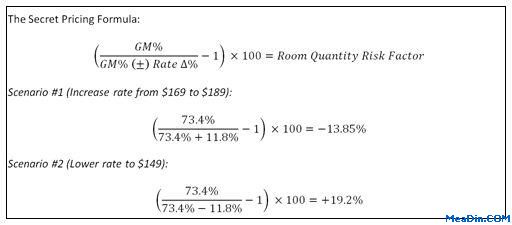
“The concept or reference rate helps us do a straight-line average of our competitors’ rates,” Stuart-Hill said.
Once you understand the secret price formula, hoteliers can see how they’re positioned against specific competitors, and “we can generate this change that gives us what’s going on in the market.”
Additionally, Sharma said to look at STR reports, as well as segment and channel mix to help evaluate your product.
Often revenue managers over-penetrate on occupancy or under-penetrate on rate, he said. “A lot of times we’re myopic or short sighted,” he said. Look to see where business is coming, and what channels that business is coming from, Sharma suggested. Comparing that to the comp set, “leads me to believe there’s potential to balance occupancy and ADR to increase RevPAR,” he said.
Sharma said it’s important to keep a medium to long-term focus.
“Business is always cyclical,” he said, adding hoteliers should never alienate their customer or make the selling process too restrictive.
“A revenue manager is an optimist and raises rates pretty quickly,” he said. “If there’s anything we learned from being in the industry, demand always goes up and down. Make sure you don’t alienate your bread-and-butter accounts.”
Consumers prefer a fixed price, Wood said. “If you have repeat groups, keeping business you currently have is easier than getting new business. Focus on pricing correctly the first time, especially for multiyear contracts,” he said.
Create an optimal mix
Part of doing this is to understand segment mix and to see what segments people fall into. Sharma said it’s important to create “what if” scenarios backed by segment strategies to gauge impact.
“If you’re moving from one segment to another, you have to back it up with some kind of past,” Sharma said. It’s important to have an optimal mix, he added, because it can help achieve higher RevPAR.
The best strategy, however, is to leverage high-rated, low-cost channels, Sharma said. To do this, he added, there has to be a strategy behind it. “Hotels have high retail rates and opaque rates are really, really low. Bring (hotel rates) down a little bit, and make them more realistic, and then you won’t have to go too low on opaque segments.”
Pricing strategy comes from looking at different segments and distribution channels. And not just third-party channels. “Make sure you have your own in-house segmentation,” Wood said. “It has to be a definable, marketable approach to track your guests.”
Business mix is especially importuning in pricing, he said, noting that understanding gross-operating-profit-per-available-room metrics and channel cost can increase top-line revenue and profitability.
Panelists agreed that many factors go into a pricing strategy, from understanding seasonal shoulder dates and peak periods to how pricing’s impact on profitability can maximize total profit.
“An increase in price doesn’t translate into an increase in average rate,” Stuart-Hill said. “I think a change in average rate impacts profitability more than you think; a negative change in rate has a (greater) impact on profitability more than you might realize.”
0


